The treatment for glaucoma involves reducing the pressure inside the eye.

Currently, this is the only way to reduce your risk of sight loss.
Though glaucoma cannot be cured it can be very well controlled. There are a number ways of doing this, such as using eye drops, performing laser or doing an operation.

Drops

Eye drops to reduce pressure are considered the first line in glaucoma treatment. As there is no cure for glaucoma, drops have to be used everyday. There are many different types of drops and they vary by the way in which they work, their side effects and the number of times they have to be put into the eye.

As putting in drops requires some hand to eye coordination some patients find it easier if a partner or family member does the drops for them. There are drop aids and compliance aides that may help in this regard and this leaflet provides more information.

Drop technique is very important when instilling drops. Once drops are in, it’s best to close the eyes and press on the side of the nose to prevent it draining into your nose or throat. It’s best not to squeeze or blink when the drops go in.

Standing at the mirror and creating a pocket to instil the drop into

Lying down and using the bridge of your nose to rest the bottle

Pressing on the side of your nose prevents the drops from draining into your nose or throat

Drop aids exist to allow easy application. Please see the leaflet for more information

Selective Laser Trabeculoplasty (SLT)

is a laser treatment designed to reduce the pressure in the eye. Along with drops it is also commonly used as the first line in the treatment of glaucoma as it has been shown to keep pressures low without drops for as long as 3 years. The treatment may require repeating a few years down the line. Many patients prefer having this laser treatment as it eliminates the side effects from drops and also means that you don’t need to remember to put the drops in.

SLT is done as an outpatient procedure and takes approximately 2-3 minutes to do. The procedure itself has a very good safety profile.
The link below shows an animation of the procedure.

If you would like to know more about this or any other procedure or would like to book a consultation then please click on this link.

Laser iridotomy

Laser iridotomy is a type of laser used to treat closed angle or narrow angle glaucoma.

It can be used after an attack of acute glaucoma or to prevent it from happening. As can be seen in the picture below the iris is causing blockage to the natural drainage system of the eye.

An opening or “hole” is made with the laser allowing the drainage system to open up.
The procedure usually takes 3-5 minutes and is done in outpatients with just a drop of anaesthetic. Mild inflammation is expected after the laser and we prescribe drops to help with this afterwards.

Minimally Invasive Glaucoma Surgery (MIGS)

MIGS is an umbrella term for the glaucoma procedures that can be done through a small incision or at the same time as cataract surgery. This type of surgery generally has a safer profile and is quicker to do.

There are many different types such as the iStent, ABiC, GATT, ECP and Preserflo shunt.
Decisions as to which is the best one for you depends on the type of glaucoma you have, how high the pressure is and the degree of damage to optic nerve.

iStent

The iStent is a titanium implant that is inserted into the eye at the time of cataract surgery to reduce eye pressure. It adds approximately 3-5 minutes to the standard cataract procedure and is done at the end of the cataract operation.

It is the smallest surgical device used anywhere in the body and has one of the best safety profiles of any glaucoma surgery. It is also safe from the point of view of MRI scans, and as it is inert will not cause a reaction or allergic response.
The procedure has a good success rate and it has been shown to reduce the eye pressure and the number of drops required to control eye pressure.

The video below shows an animation of the implant.
If you would like to know more about this or any other procedure or would like to book a consultation then please click on this link.

ABiC or GATT

Ab interno canaloplasty (ABiC) and Gonioscopic Assisted Transluminal Trabeculotomy (GATT) are minimally invasive procedures done with a very small catheter. Though usually done at the time of cataract surgery, they can be done as stand-alone procedures as well. They work in a similar fashion to the iStent (as shown above) but are generally reserved for patients with
higher pressures.

Unlike the iStent, no implant is left in the eye. Though a very safe procedure, this type of surgery carries more risk such as bleeding and inflammation. This however settles down over a period of 1-3 weeks.

The video below shows an animation of the procedure.
If you would like to know more about this or any other procedure or would like
to book a consultation then please click on this link.

Endocyclophotocoagulation (ECP)

ECP is a type of laser done at the same time as cataract surgery for patients with more aggressive disease. It is generally reserved for conditions where an iStent, GATT or ABiC (see above) cannot be performed as the drainage angle shows severe damage or the patient is not medically fit for more aggressive glaucoma surgery such as a trabeculectomy or tube surgery (see below).

Patients settle quickly following this procedure, though rarely some may have more persistent inflammation following surgery.
The video below shows an animation of the procedure.
If you would like to know more about this or any other procedure or would like
to book a consultation then please click on this link.

Preserflo shunt

The Preserflo MicroShunt is a small tube like device that allows excess fluid to drain from the inside of the eye to an area above the eye, under the upper eyelid. It is reserved for patients who have high pressures and continued damage to their optic nerve and visual field.

The procedure is done as day surgery so you do not have to stay in hospital.
An injection of local anaesthetic is given around the eye to numb it. The operation itself takes about 30-40 minutes and patients find this operation allows them to get back to their normal life a lot quicker.
The operation has a very high safety profile particularly when compared to the more traditional glaucoma operations such as trabeculectomy and glaucoma drainage implants.

If you would like to know more about this or any other procedure or would like
to book a consultation then please click on this link.

Trabeculectomy

The trabeculectomy has long been regarded as the “gold standard” operation for glaucoma. It has been used since the 1960s and with the use of modern techniques it has a very high safety profile. It tends to be offered to patients with high pressures and worsening glaucoma.

It can be done under both a local or general anaesthetic but does not require a hospital stay. Patients are then seen the following day and then weekly for about 4 weeks.

In essence, the operation involves creating a hole in the white part of the eye (sclera). This hole allows fluid to drain out of the eye and which in turn brings the pressure inside the eye down. The hole itself is covered with a flap that allows the pressure to be regulated.
As with all glaucoma operations the aim isn’t to cure glaucoma but to reduce or even halt further damage from occurring.
The link below shows an animation of the procedure.
If you would like to know more about this or any other procedure or would like
to book a consultation then please click on this link.

Tube

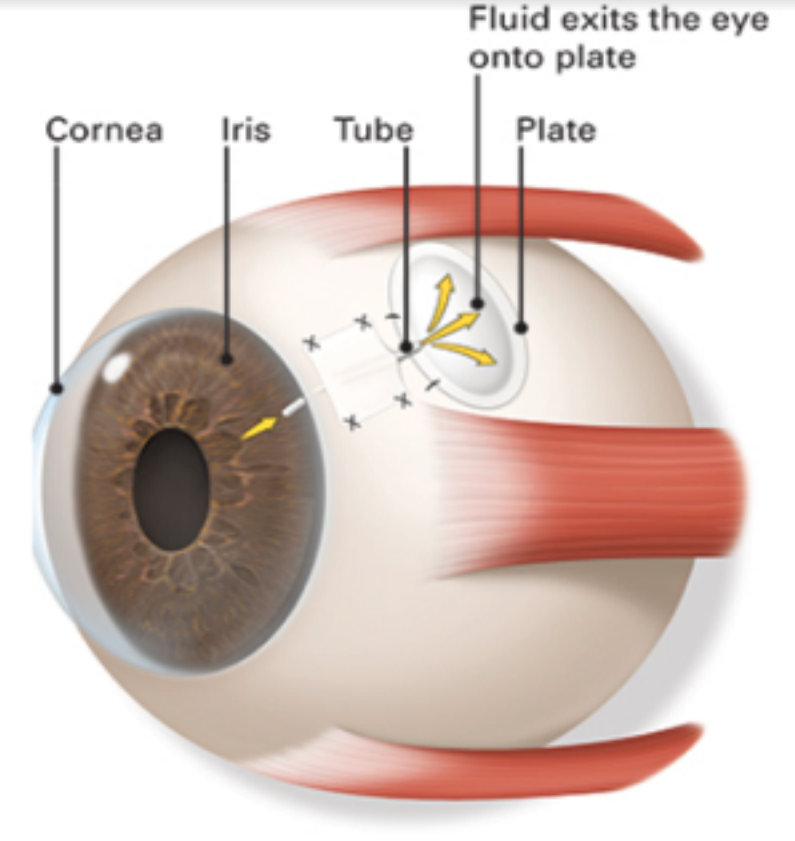
Tube operations, also known as glaucoma drainage devices (GDD) or glaucoma drainage implants (GDI) are implants that allow fluid from the inside of the eye to drain to the outside. This in turn allows the pressure inside the eye to be lower. Lowering the pressure inside the eye can reduce the chances of further damage to the optic nerve but it can’t reverse the damage that’s already happened.

The operation is usually reserved for patients with more complex glaucomas and very high pressures. This operation works particularly well in patients in whom other glaucoma surgeries have failed or who are not suitable for the other operations mentioned previously.
It usually takes between 60 to 120 minutes to perform. As it takes longer to do
than other glaucoma procedures it is generally done under general anaesthesia, though it can be done using a local anaesthetic under certain circumstances.

The operation takes about 3 months to become fully operational. This is done to allow the eye to heal around the tube. A small stitch is tied around the tube and another stitch is placed inside the tube to reduce its function for 3 months.
At around 3 months the stitch is removed to allow the operation to work fully.

The link below shows an animation of the procedure.
If you would like to know more about this or any other procedure or would like to book a consultation then please click on this link.